Principle of Operation
Doppler Systems’ direction finders use the principle of operation – the Doppler Effect – first described by physicist Christian Doppler in 1842. Doppler discovered that frequencies increase as two objects move toward each other. However, they decrease as they move away from each other. A rotating antenna achieves the motion of one object relative to another in the radio frequency spectrum. As the antenna moves toward the signal source, the received frequency increases. As it moves away from the signal source, it decreases. For example, see the following illustration.

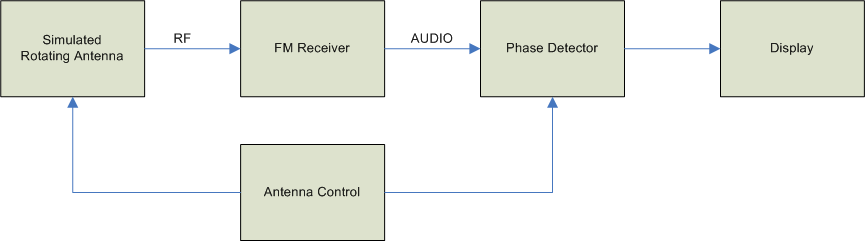
As a result, the received signal FM modulates at the frequency of antenna rotation. Applying the modulated RF signal to the input of a narrow band FM receiver produces a tone at the audio output of the receiver at the antenna rotation frequency (sometimes called the commutation or sweep frequency). This tone superimposes on the normal audio output. The phase of the tone (relative to the clock reference used to sweep or rotate the antenna) is the bearing angle. The direction finder processes this audio signal to calculate and display the bearing angle.
In order to produce a usable signal, the rotational rate of the antenna must rotate at greater than 20,000 rpm. Clearly this rate of rotation is impractical. Instead several antennas (usually 4, 8, or 16) are arranged in a circle and electronically rotated. Direction finders using this principle of operation are sometimes referred to as pseudo-Doppler or synthetic Doppler.
Applying the modulated RF signal to the input of a narrow band fm receiver produces a tone at the audio output of the receiver at the antenna rotation frequency. Two other names are the “commutation” or “sweep frequency”. This tone superimposes on the normal audio output. The phase of the tone (relative to the clock reference that sweeps or rotates the antenna) is the bearing angle. Thus, the direction finder processes this audio signal to calculate and display the bearing angle.
For example, a simplified diagram of the Doppler principle of operation appears below.